Insight into Technology
In electronics manufacturing, every IC must be programmed with the correct firmware before it is assembled onto a PCBA. During production, a recurring challenge was identified where unprogrammed ICs could be loaded and soldered onto PCBAs, with the issue only being discovered during functional testing.
At that stage, correcting the problem required the IC to be desoldered, programmed, and reworked – adding unnecessary cycle time, manual effort, and risk to the product. To address this challenge, the Kitron Global Automation Team developed an Automated IC Programming Machine that moves programming and verification to an earlier stage of the process.
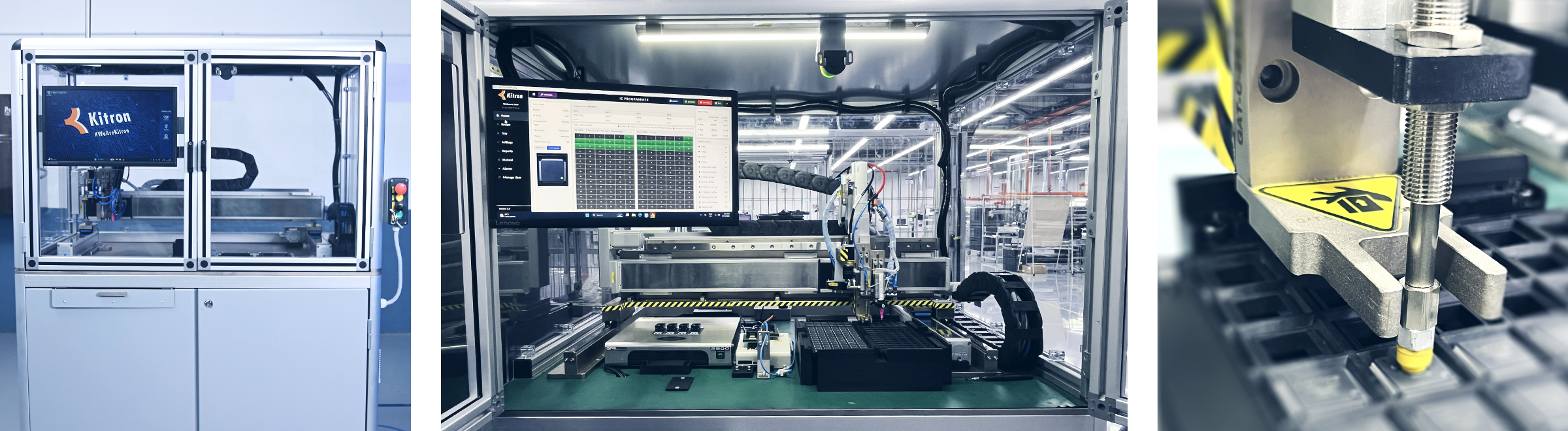
The machine automatically handles, inspects, programs, verifies, sorts, and marks each IC, ensuring that only successfully programmed components are released for production.
How Does it Work?
The process starts with loading a tray of unprogrammed ICs into the machine. Once loaded, the integrated vision system automatically checks each IC for presence, position, orientation, and visible physical damage before any handling takes place.
After the inspection is completed, the servo-driven pick-and-place system uses a vacuum end effector to accurately pick each IC and place it into the programming socket.
The required firmware is then programmed into the IC and immediately verified to confirm that the programming has been completed successfully.
Based on the result, the machine automatically sorts the ICs. Successfully programmed components are placed in the output tray and marked for clear identification, while failed or unprocessed components remain separated for further action.
This creates a controlled process from inspection and programming to verification, identification, and production-ready components.
Key Features & Benefits
- Automated IC Handling – Accurate and repeatable transfer reduces manual handling.
- Inspection & Verification – Ensures the correct component is processed and programming is successfully completed.
- Automatic Sorting & Marking – Separates failed components and clearly identifies programmed ICs.
- Process Visibility – Provides real-time status, pass/fail results, and tray information.
Have an Automation Challenge?
If your site is facing a recurring production challenge, manual process, quality issue, or an opportunity for automation, reach out to the Kitron Global Automation Team (GAT).
Working closely with our production teams helps us identify practical automation opportunities and develop solutions that can be standardized and reused across Kitron's global operations.